Picture this: the balance beam just arrived, the mat is rolled out in the garage, and your athlete is already eyeing the dismount. Then you look down and realize — the beam is sitting on bare concrete, and the landing zone is a single inch of foam you grabbed from the craft store. That gap between “we have the equipment” and “the equipment is actually safe to use” is exactly what this article is about.
Flooring is the unsexy part of the gymnastics setup conversation. People spend weeks comparing beams and bars, then pick whatever mat is cheapest and in stock. But the surface under your equipment is doing real structural work: absorbing landing impact, preventing equipment slip, and in some states, determining whether your training space can be covered by a homeowner’s or facility insurance policy. Getting it wrong doesn’t just risk injury — it can mean a beam that rocks, a spring mat that bottoms out, or a tumbling strip that migrates three inches every session. This guide will help you match the right flooring option to the right use case, with clear tradeoffs spelled out at every tier.
| EDITOR'S PICKFlooringInc's Rollout Carpet To… | Mid-tier[BalanceFrom 6x2 Feet 3-Panel Fo…](https://www.amazon.com/dp/B097HTMFVB?tag=greenflower20-20) | Budget pick[bemaxx Gym Mats Set - 18 pcs EV…](https://www.amazon.com/dp/B0F99N39T7?tag=greenflower20-20) | |
|---|---|---|---|
| Thickness | 1.38 in | 2 in | 0.4 in |
| Dimensions | 5 ft x 10 ft | 6 ft x 2 ft | 12.6" x 12.6" each |
| Material | Carpet top | Vinyl surface | EVA foam |
| Portable | — | ✓ | — |
| Assembly | Roll out | Folding | Interlocking tiles |
| Price | $349.99 | $36.99 | $26.99 |
| See on Amazon → | See on Amazon → | See on Amazon → |
The Three Options, Defined
Before you can pick, you need to know what each product actually does.
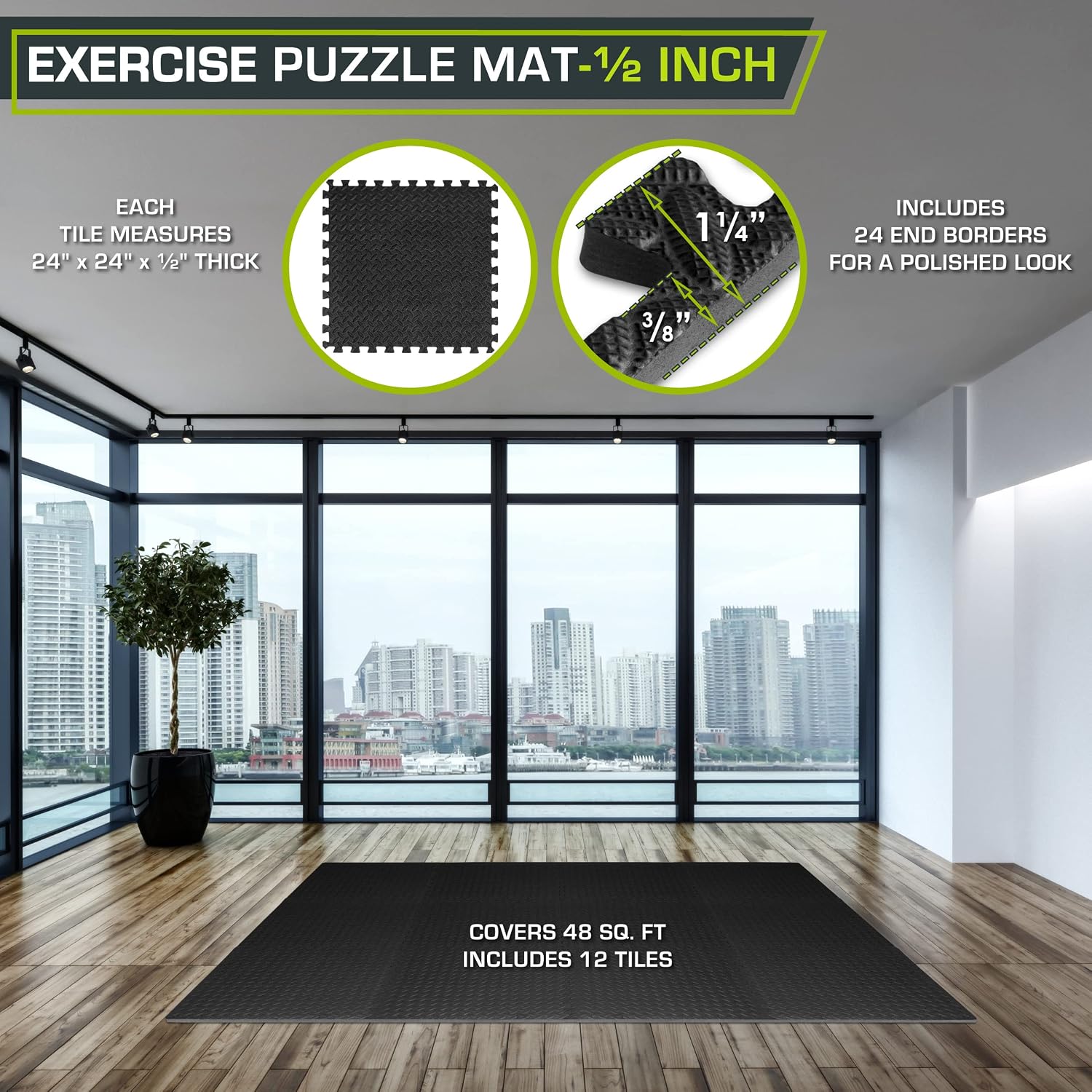
Foam tiles (also called EVA foam interlocking tiles — EVA stands for ethylene-vinyl acetate, the same material in athletic shoe midsoles) are puzzle-piece squares, typically 3/8 inch to 1 inch thick, that you snap together to cover an area. They’re the default “home gym floor” product you’ll find at sporting goods retailers. They cushion impact and protect subfloor surfaces from equipment feet.
Rubber mats range from thin stall mats (3/4 inch, originally designed for horse stalls, now a staple of strength and conditioning gyms) to thicker crash mat platforms and landing pads. Rubber provides durability and equipment-grip that foam typically can’t match. The tradeoff is weight and cost.
Carpet roll — specifically, gymnastics carpet bonded to a closed-cell foam backing — is what you see on recreational gym floors and home practice surfaces. It looks and feels like a traditional floor but provides a defined, consistent surface for cartwheels, round-offs, and floor work.
Each has a distinct performance profile. The decision isn’t really “which is best” — it’s “which is right for this equipment and this athlete.”
By the Numbers
| Flooring Type | Typical Thickness | Approximate Cost (2026) | Best Use Case |
|---|---|---|---|
| EVA Foam Tiles (3/8”) | 3/8 in | $0.50–$1.00/sq ft | Light equipment, cartwheel zones |
| EVA Foam Tiles (1”) | 1 in | $1.25–$2.50/sq ft | Under low beams, conditioning areas |
| Rubber Stall Mat | 3/4 in | $1.50–$2.25/sq ft | Under heavy apparatus, strength work |
| Gymnastics Carpet Roll | 1–1.5 in (incl. backing) | $2.00–$4.50/sq ft | Floor ex strips, rec practice areas |
| Gymnastics Landing Mat (4”) | 4 in | $3.00–$6.00/sq ft | Beam/bar dismount zones |
Costs reflect typical retail and wholesale pricing as of May 2026; institutional/bulk pricing will be lower.
Matching Flooring to Equipment and Training Level
This is where practitioners tend to make the most expensive mistakes: buying one floor type and expecting it to handle every use case.
Foam Tiles: The Right Call and the Wrong One
EVA foam tiles are the right choice for a defined set of applications. Based on published spec comparisons across major sport flooring brands, 3/8-inch tiles offer minimal fall protection but provide adequate cushioning for equipment feet on hardwood or concrete subfloors. They prevent scratching and reduce vibration transfer. That’s it. Owners and coaches consistently note in long-form forum reviews (gymnasticshq.com community discussions) that 3/8-inch tiles compress almost completely under a loaded balance beam, which means you’re not getting the protection the tile’s marketing implies.
The 1-inch tile is a different product. At that thickness, EVA foam provides meaningful impact attenuation for moderate falls — a child tumbling from a 12-inch floor beam, a gymnast practicing handstands. The Wirecutter’s overview of home gym flooring (nytimes.com/wirecutter) consistently rates 1-inch EVA tiles as appropriate for recreational home workout spaces but flags that they are not a substitute for engineered landing surfaces under apparatus above 2 feet.
The practical decision rule: if the equipment is under 18 inches and the gymnast is under Level 4, 1-inch foam tiles for the full floor area plus a dedicated landing mat for dismounts is a defensible setup. Above that combination, you’re leaning on the tiles to do work they weren’t rated for.
One underrated foam tile failure mode: migration. Interlocking puzzle tiles shift under repeated lateral movement. If your athlete is doing floor work — round-offs, back walkovers, any tumbling sequence — the tiles will creep. Rubber-backed tiles help, but reviewers across home gym communities consistently report that no tile system fully eliminates drift on a smooth concrete garage floor without adhesive or a border frame. Plan for it.
Rubber Mats: The Workhorse for Apparatus Zones
For the under-equipment zone specifically — the footprint directly beneath a freestanding beam base, a bar upright, or a vaulting springboard stand — rubber stall mats are the most cost-effective high-durability option at the 2026 price point. At 3/4 inch, they don’t compress the way foam does under equipment weight. Manufacturer-rated load capacity for standard 4x6 rubber stall mats typically runs 150+ lbs per square foot before any meaningful deformation, and operators in long-run reviews consistently note 5–8 year lifespans in busy home gym contexts.
The real reason rubber wins in apparatus zones is friction. A beam base sitting on rubber doesn’t walk. A bar upright on rubber doesn’t shift when a Level 6 athlete loads a cast. That stability matters for safety and for the feel of the equipment — gymnasts and coaches note that beam wobble on a slippery or compressible surface changes how the beam “feels” underfoot in ways that affect training and confidence.
The tradeoff: rubber is heavy (a single 4x6 mat runs 90–100 lbs), hard to cut, and unpleasant to land on directly. No one should be dismounting onto bare rubber mat. It’s a foundation layer, not a landing surface.
The institutional application of this principle is worth noting: USA Gymnastics’ facility safety guidelines (usagym.org, Safety Handbook) describe requirements for apparatus placement that effectively mandate stable, non-slip underlayment for all freestanding apparatus. Rubber underlayment is the most common way facilities meet that requirement at the zone level without installing a full spring floor.
Gymnastics Carpet Roll: When You’re Building a Practice Floor
Bonded carpet — a short-pile nylon carpet face bonded to a closed-cell polyurethane foam backing — is the product category that creates actual “gymnastics floor” feel. This is what you’re speccing if you’re building a dedicated floor exercise strip (typically 12x24 or 12x40 feet), a rec-gym warm-up area, or a home practice room that needs to handle volume.
The key spec is backing density. Published spec sheets from major gymnastics flooring suppliers typically show backing densities ranging from 2.5 to 8 lbs/cubic foot. Lower-density backing (2.5–4 lb) is appropriate for recreational and home use; it provides cushioning for tumbling basics and reduces impact on hardwood subfloor. Higher-density backing (5–8 lb) is what you find in club and collegiate settings where the floor needs to hold shape under repeated high-impact loading.
The ASTM F355 standard (American Society for Testing and Materials, impact attenuation testing) is the reference point for how these products are rated. Gymnastics carpet roll marketed to competitive facilities should carry a documented ASTM F355 result or equivalent; products that don’t publish this number are implicitly in the recreational segment regardless of how they’re positioned. The Consumer Product Safety Commission’s Handbook for Public Playground Safety uses similar attenuation frameworks for fall-zone surfacing, and the underlying physics apply: a surface’s ability to slow deceleration across a fall distance is what determines whether it’s protective or decorative.
The practical decision rule for carpet roll: if you’re buying 200+ square feet and training tumbling at Level 3 or above, you want documented backing density and ideally an ASTM attenuation figure from the manufacturer. If you’re buying a 6x12 strip for cartwheel practice for a recreational athlete, the spec sheet matters less than coverage and durability.
The Layered System: What Serious Setups Actually Use
Here’s where intermediate practitioners often have the useful insight: the answer isn’t one flooring type — it’s zones.
A well-designed home or small-facility setup typically uses:
- Rubber mat under every apparatus base — non-negotiable for stability and equipment protection
- Foam tile or carpet roll for the general training floor area — sized to the practice footprint, not just the equipment footprint
- Dedicated landing mats (4-inch minimum) in the dismount zone — placed on top of the floor surface, replaced when compression depth exceeds 20% of original thickness
This layered logic is exactly what USA Gymnastics and facility insurance underwriters expect to see in a compliant training space. It also happens to be more cost-effective than trying to solve all three problems with one product.
The math favors layering: rubber stall mats for a 4x8 apparatus zone run approximately $60–$80 at 2026 retail pricing. Trying to substitute a thicker foam tile that handles both stability and landing protection will cost more and perform worse on both dimensions.
The Decision Framework
If X, then Y:
- If the athlete is recreational and the apparatus is under 18 inches → 1-inch EVA foam tiles for the floor zone, a standalone 4-inch landing mat for dismounts, rubber mat under equipment feet.
- If the athlete is Level 4–6 training at home or in a satellite program → rubber underlayment under all apparatus, gymnastics carpet roll (4–6 lb backing density) for the training floor, 4-inch landing mats in all dismount zones.
- If you’re speccing a club, satellite gym, or dedicated practice room (200+ sq ft) → request ASTM F355 documentation from every flooring vendor, use rubber in all apparatus footprints, and budget gymnastics carpet roll as a capital line item with a 5-year replacement cycle.
- If you’re on concrete subfloor in any scenario → add rubber underlayment regardless of what goes on top. Concrete transmits impact and moisture in ways that accelerate foam degradation and increase fall-injury risk.
The floor is the last thing athletes and parents think about and one of the first things that determines whether the whole setup is actually safe. Getting the zoning right isn’t overengineering — it’s the difference between a practice space that trains confidence and one that quietly accumulates risk.