A back handspring — where a gymnast jumps backward, arches through a bridge position in the air, and lands on their hands before snapping back to their feet — is one of the most psychologically demanding skills in the sport. The challenge isn’t usually strength. It’s trust: trusting your body to commit backward through the air when every instinct says stop. That’s exactly why home training aids exist. Two tools consistently come up in club-gym parent groups and recreational training circles: the air barrel (an inflatable cylindrical cushion, roughly the size of a large suitcase) and the octagon mat (a rigid-foam, eight-sided prism that stays fixed on the floor). Both are designed to help a gymnast feel the arc of the skill safely before doing it freestanding. But they work differently, cost differently, and suit different training stages. This article breaks down the real-world tradeoff so you can decide which — if either — belongs in your garage, basement, or backyard.
What Each Tool Actually Does (and the Physics Behind It)
Let’s start with the mechanism, because understanding what the tool does makes the buying decision obvious.
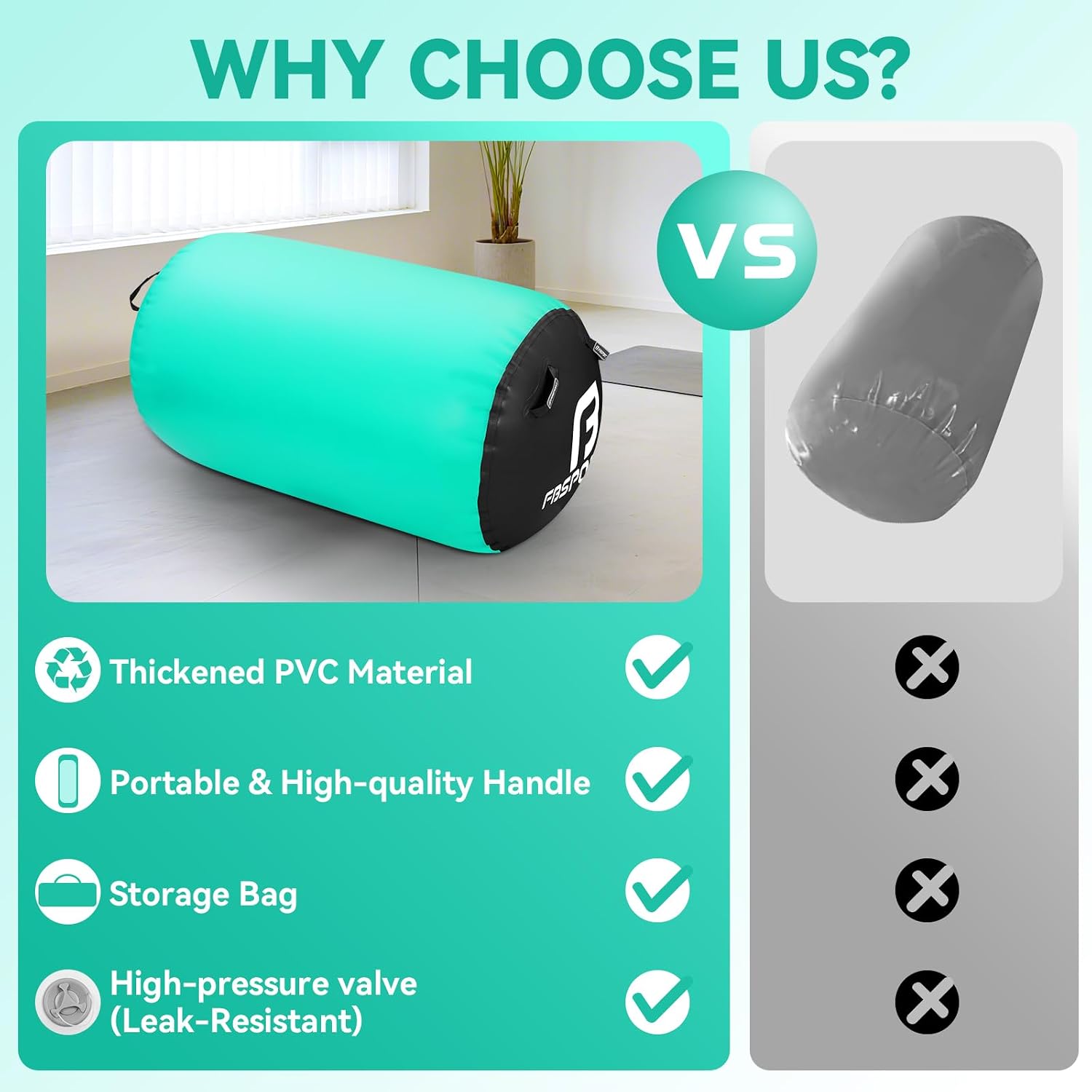
The air barrel is inflatable — typically 36 to 48 inches in diameter and filled to a firmness you control by adding or releasing air. When a gymnast sits on top and falls backward over it, the barrel catches the arch of their back mid-flight, giving them a tactile reference point for where their hands should land. The inflation level matters enormously: too firm and it acts like a hard roller, bouncing the athlete off unpredictably; too soft and it collapses under load and provides no useful shape cue. Owners of Tumbl Trak and Gymnastics Direct–stocked air barrels consistently report that the sweet spot is a medium-firm inflation where the surface gives slightly but holds shape through the motion.
The key biomechanical service the air barrel provides is position feedback mid-skill. It tells the athlete’s nervous system: this is what the extended arch feels like when timed correctly. That’s its job. It does not simulate floor rebound. It does not teach the snap-down leg drive that completes the skill. It teaches the shape.
The octagon mat (also sold as an octagon block or octagon prism) is a dense foam eight-sided form, usually 20 to 24 inches tall and 48 inches wide. Because it’s rigid foam rather than inflatable, it stays exactly where you put it and doesn’t shift under load. A coach or spotter can kneel on one side while the athlete practices the kick-over motion from a seated or standing start. It is fundamentally a stationary contact surface — it catches the athlete during the backward lean phase and provides a stable base for repeated rep drilling.
The tradeoff between the two tools comes down to one word: compliance. The air barrel is compliant (it gives, it moves, it adjusts to the body). The octagon is not. That compliance difference changes what stage of learning each tool serves.
The Learning-Stage Match: When to Use Which
GymnasticsHQ’s step-by-step back handspring progression describes a clear skill ladder: bridge kickover → standing backbend → back walkover → spotted back handspring → independent back handspring. Air barrels and octagons don’t sit at the same rung of that ladder.
Use the octagon mat when:
- The athlete is still working on backbend and bridge comfort — the octagon’s stable surface lets them practice the foundational arch shape without any fear of rolling off
- The athlete is early in back handspring drilling and needs a non-moving surface they can push against to feel the “jump and reach back” takeoff
- You want a dual-use tool (the octagon is excellent for handstand shape work, round-off drills, and back walkover progressions — it earns its floor space)
- Budget is a constraint: foam octagons from brands like Z-Athletic and Tumbl Trak typically run $60–$130 at retail, depending on density and size
Use the air barrel when:
- The athlete has already cleared backbend and bridge work and is specifically drilling the back handspring arch — they need the mid-flight position cue, not foundational bridge practice
- The athlete has fear/block around committing backward and needs the psychological safety of a “catch” behind them during the launch
- A coach or parent can be present to spot alongside the barrel — the barrel is a training aid, not a substitute for a human spotter
- You can manage the inflation routine (the barrel needs checking before each session; under-inflated barrels are a documented misuse issue per USA Gymnastics risk management guidance)
- Budget allows: air barrels in the 36–48-inch range run $120–$280 depending on brand and construction quality
By the Numbers
| Tool | Typical Price Range | Best Training Stage | Dual-Use Value | Portability |
|---|---|---|---|---|
| Foam Octagon Mat | $60–$130 | Backbend → early BHS | High (handstands, walkovers) | Moderate (bulky but light) |
| Air Barrel (36–42 in.) | $120–$200 | Mid-BHS drilling, fear block | Low–Moderate | Good (deflates flat) |
| Air Barrel (48 in.) | $180–$280 | Advanced arch/timing drills | Low | Good (deflates flat) |
When Neither Tool Solves the Problem
Here’s the part most product descriptions skip: both tools have real failure modes.
The air barrel doesn’t fix a technique problem. If an athlete is rushing the jump, dropping their chin, or piking at the hips before hand contact, the barrel will let them complete a sloppy version of the motion and reinforce the error. As NASPE’s guidelines on movement arts instruction emphasize, repeated practice of an incorrect pattern builds a stronger incorrect motor program — not a weaker one. If you’re seeing consistent technical errors (chin drop, bent knees on the arch, early hip pike), the barrel is not the right investment. A single coached session in a gym is.
The octagon doesn’t fix fear. If an athlete has a genuine psychological block — the kind where they know the skill technically but freeze at the point of commitment — the stable, non-moving octagon often isn’t enough to break through it because it doesn’t simulate the sensation of the skill. Experienced coaches tend to reach for the air barrel or a foam pit for fear-block work, not the octagon.
Home training without a spotter carries real risk. USA Gymnastics’ safety documentation is explicit: backward tumbling skills, including back handspring progressions, should be spotted by a trained person during the learning phase. Neither the barrel nor the octagon replaces a human spotter. If the athlete is working alone, the safest home use of either tool is positional drilling (static bridge over the barrel, backbend holds on the octagon) — not full-speed back handspring attempts.
Surface matters more than the tool. Both tools perform differently on carpet, grass, hardwood, and rubber gym flooring. Grass is forgiving but inconsistent. Carpet adds friction that can snag hands on contact. Owners report that air barrels used on grass can shift laterally during the drill, which creates a different (and potentially misleading) movement cue than a level floor. If your home setup is grass or low-pile carpet, factor that into expectations.
Choosing the Right Size and Density
If you’ve decided one of these tools fits your athlete’s current training stage, size selection matters more than brand.
For air barrels: The 36-inch diameter is generally recommended for athletes under age 12 or under approximately 80 lbs — the arc is sized closer to the actual skill arc at smaller body proportions. The 42-inch barrel is the most commonly recommended all-purpose size for club-level athletes in the 10–16 age range. The 48-inch barrel is used in competitive training settings where athletes are drilling with more speed and need a larger catch zone, but it’s oversized for foundational home drilling.
Tumbl Trak’s specification documentation for their air barrel line identifies 200 lb as the typical rated user weight for their standard training barrel — relevant if the user is a teenager or adult learning the skill later.
For octagon mats: Density is the variable that separates a usable training tool from a mat that compresses under load. Look for a density spec of at least 1.9 lb/cu ft for foam products — this is the threshold below which owners consistently report premature compression and loss of shape over months of use. Brands like Tumbl Trak and Z-Athletic publish foam density in their spec sheets; if a listing doesn’t include density, it’s often a signal that the foam is on the lower end.
Height matters too: a 20-inch octagon suits athletes working on early bridge and backbend comfort; a 24-inch octagon is the standard for back handspring drilling because it better approximates the height of the athlete’s center of gravity at the skill’s takeoff point.
The Decision Rule
If you’re the parent or coach making this call right now, here’s the simplified framework:
If the athlete is still working on bridge comfort, backbend flexibility, or back walkover → buy the octagon. It’s cheaper, more durable, and genuinely useful across multiple skills in the foundational progression. It will still be useful after the back handspring is mastered. The foam octagon is the more defensible capital allocation at this stage.
If the athlete has clean backbend mechanics and is specifically stuck on back handspring commitment or timing → the air barrel addresses that specific problem better than the octagon. Buy the 42-inch size unless the athlete is small or the budget is tight.
If the athlete has a coach-identified fear block that hasn’t responded to standard spotted drilling → neither tool alone is the answer. Consistent coached reps in a gym with a foam pit or crash mat is the correct prescription, and GymnasticsHQ’s back handspring guide makes this point directly: fear blocks in backward tumbling are neurological, not mechanical, and they respond to volume of successful experiences in a low-consequence environment — which a supervised foam pit provides better than any home apparatus.
If the home training space is a garage or basement with a 4x6 rubber mat and no foam pit → the octagon is safer for unsupervised use. Its fixed position means it can’t roll away during a drill gone wrong, which the inflated barrel can in certain surface conditions.
Neither tool is a shortcut to an independent back handspring. Both are legitimate training accelerators when matched to the right stage. The mistake most families make is buying based on what looks impressive in a product photo rather than what the athlete actually needs at their current point in the progression. Buy for the stage the athlete is in today, not the skill they want in three months.